
History of the Agathawirt in Bad Goisern
Almost 400 years of proven hospitality in the Salzkammergut
The area around Bad Goisern has been a centre of the salt trade for centuries, attracting many people and especially workers. Settlement in the Bad Goisern region can already be traced back to the Neolithic period almost 4500 years ago. And one of the most famous groups who mined salt here are the Romans.
Landgasthof for almost 400 years
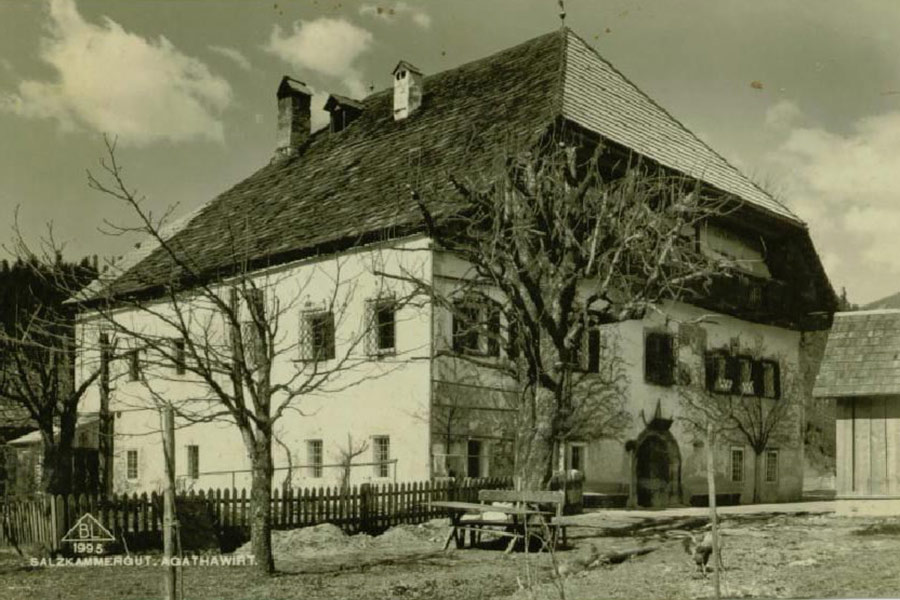
Historical findings prove that there was already a tavern or inn on the site of today's Landhotel Agathawirt in Roman times. There is no clear evidence of this, but the history of the house is written down in some old letters. The building of the Landhotel Agathawirt was built at the beginning of the 16th century and was first mentioned as an inn in 1644, almost 400 years ago.
Building and architecture - peculiarities of folklore, Renaissance & Baroque
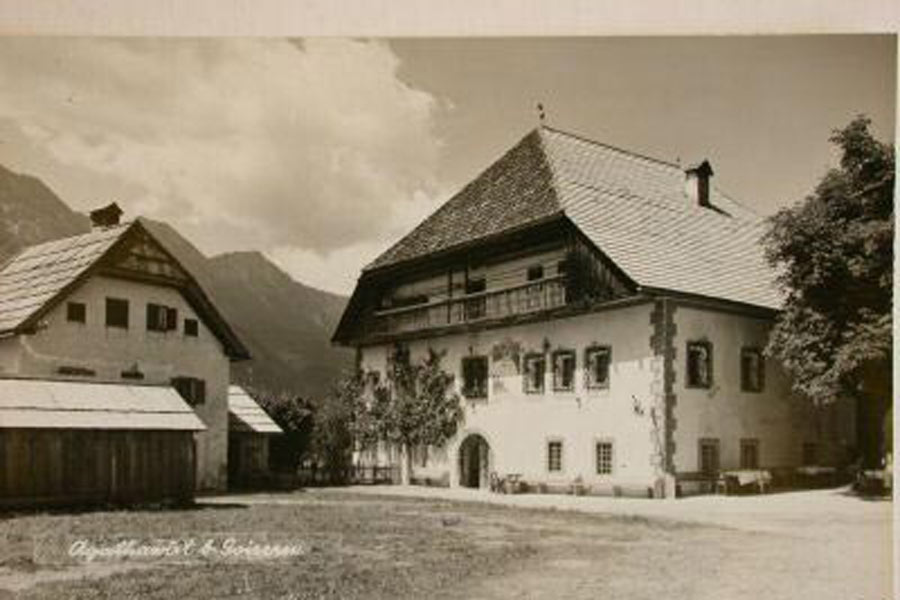
Today's Landhotel Agathawirt is a wonderful product of vernacular architecture and the Renaissance. Many characteristics and peculiarities can be traced back to the folk architecture of the early Bad Goiserer, others to the special balance and austerity of the Renaissance. Many embellishments and extensions to the building were not added until 1623. This, in turn, is impeccably attested by the engraved and chiselled year in the marbled entrance portals or, for example, the wall fountain.
Other features of the centuries-long existence and constant expansion are early baroque elements of the architecture. Classical round-arched windows, ornate wrought-iron window baskets, marble entrance portals with angel-head ornamentation, the Gwandtner walkway, three lavabos, old murals with religious motifs and vaulted halls with entrances to the guest rooms. A particularly beautiful highlight of Baroque architecture is the coffered ceiling in the guest room.
Development of the house and the region
The salt mining in Hallstatt was particularly influential for the development of the house, as well as for the entire Bad Goisern region. This was the cornerstone of the local society at the time, which also led to the expansion of goods and passenger transport via the Pötschen and thus gave the Agathawirt country inn an important role: as a changing station for the stagecoach.
World-famous artists at the Agathawirt
At the beginning of the 18th century, the Austrian Salzkammergut was discovered by a new kind of people: the artists. Mainly painters and writers found their creative refuge in the green valleys and picturesque lakes and created numerous well-known works. In painting and writing, the artists immortalised their thoughts, desires and fears while being inspired by the impressive landscapes.
Adalbert Stifter (1805 - 1868)
Adalbert Stifter, who holds a place of honour in Austrian cultural history not only as a poet but also as a painter, was also attracted by the beautiful landscape of the Salzkammergut. As is well known, it served him as a model for at least six oil paintings and five drawings. One of the drawings is a pen and ink drawing entitled "St. Agatha filial zu Goisern", which shows the view of the Catholic church of St. Agatha and the rear view of the Agatha innkeeper and was created by Adalbert Stifter around 1836. (Unfortunately, this pen and ink drawing is lost today).
Gustav Klimt
Gustav Klimt spent several summers in St. Agatha from around 1897 to 1900. Three works have survived from this time in St. Agatha: "Garden with Chickens in St. Agatha", 1898, originally titled "After the Rain"; "Birch Tree near St. Agatha", around 1900 and "Orchard in the Evening", also around 1900.
Rudolf von Alt (1812 – 1905)
Rudolf von Alt was one of the famous guests of the Agathawirt. He immortalised the house during one of his last summer stays in the Salzkammergut with a watercolour painting: "Im Gastgarten von Sankt Agatha am Fuße des Pötschen" - 1903.
Spa and imperial town of Bad Ischl
Another breakthrough for the region around Bad Goisern was the development of the brine bath in Bad Ischl, the forerunner of today's thermal baths in Bad Ischl. This was quickly known throughout the country and also became one of the meeting places for the distinguished public, as well as for the imperial court of the Austro-Hungarian Empire. The emperor's court in particular enjoyed regular excursions to Bad Ischl, Bad Goisern and St. Agatha.
But other famous personalities also stopped off here and there in Bad Goisern. For example, King Otto of Greece stayed for several days at the Agathawirt country hotel in August 1850 when he was passing through.
On 8 April 1888, on the occasion of the 40th anniversary of the reign of Emperor Franz Josef, an oak tree, the so-called "Kaiserreiche zu St. Agatha" was planted, which still stands today next to a 200-year-old chestnut tree and casts a cooling shadow in the guest garden of the Agathawirt on decidedly hot summer days.
Lived hospitality at the Landhotel Agathawirt
Visit the Landhotel Agathawirt and enjoy the traditional hospitality first hand. Send us your non-binding enquiry and spend relaxing days in the Salzkammergut or let us spoil you with culinary delights in the restaurant. We look forward to your visit!

